KeyTec® Fluorescent Cell Viability Detection Kit
Size:
Price: $ 144
CAT.: A2010301N
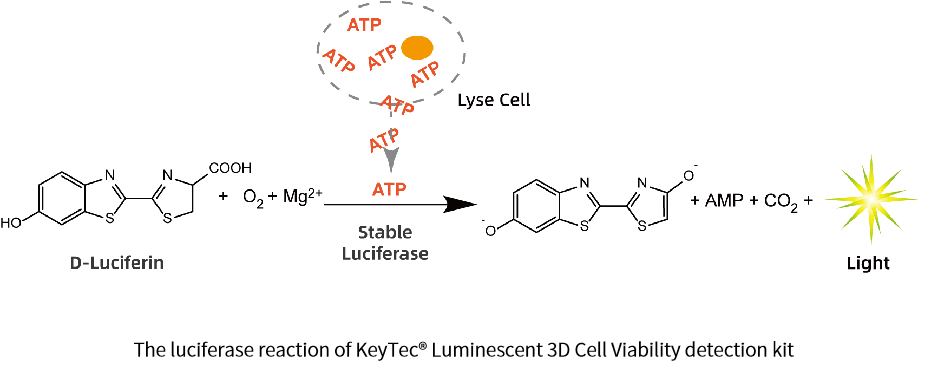
KeyTec® Luminescent 3D Cell Viability Detection kit (3D LCV) is designed for 3D cell viability detection. It quantifies viable cells by measuring the ATP present, a key indicator of metabolically active cells. The homogeneous assay procedure involves adding a single reagent directly to 3D cells cultured in serum-supplemented medium.
The detection principle is based on Luminescent technology. Within the kit, D-Luciferin and luciferase react with ATP released by 3D cells, generating a sensitive and robust luminescent signal. With a luminescent signal half-life of 3-5 hours, this kit ensures high sensitivity and robust performance, making it an ideal choice for high-throughput screening (HTS), 3D cell proliferation and cytotoxicity assays.
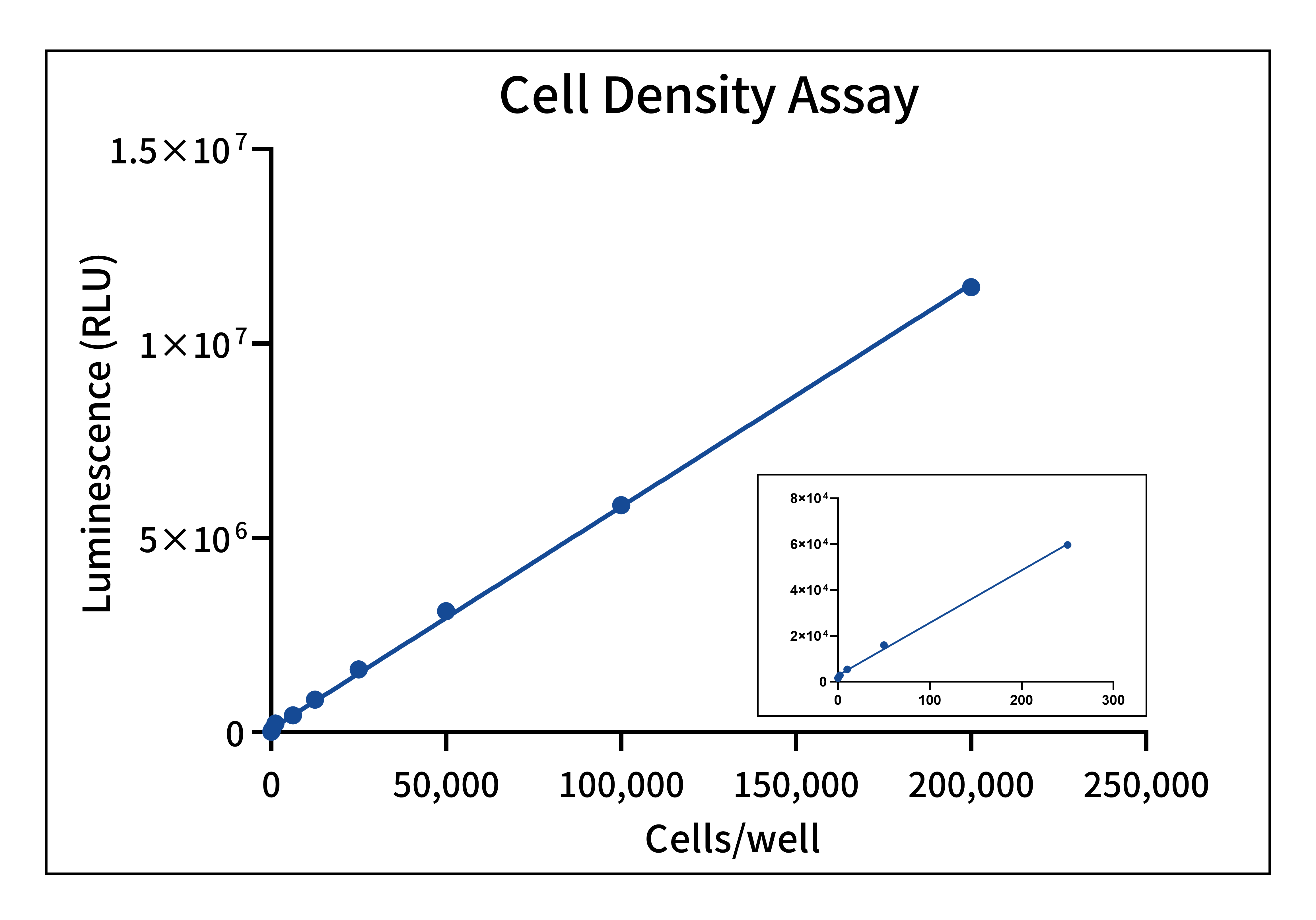
Use KeyTec® Luminescent 3D Cell Viability Detection kit to detect 3D cell viability of Hela cell line. The results showed a linear relationship between the luminescent signal and the number of cells (5 - 200,000 cells/well). Hela cells, cultured in RPMI 1640 medium with 10% FBS, were serially diluted two-fold, starting from 200,000 cells per well in a 96-well plate. Perform the assay according to the procedure outlined in Section 5.“Assay Procedure”. Ten minutes after adding the reagent, measure the luminescent signal using the Envision's Luminescence program. (Example program details include Mirror: Luminescence, Em filter: Luminescence 700, Measurement height: 6.5 mm, and Measurement time: 1 s).
| CAT. | Description | Size |
| A2010301N | KeyTec® Fluorescent Cell Viability Detection Kit | 10 mL |
|
Each kit contains sufficient reagents to perform 100 tests of 100 μL/well. |
||
| Certificate of Analysis | Limitations | Storage Conditions |
| LOT. | For research use only |

-20 ℃ |
KeyTec® Luminescent 3D Cell Viability Detection kit (3D LCV) is designed for 3D cell viability detection. It quantifies viable cells by measuring the ATP present, a key indicator of metabolically active cells. The homogeneous assay procedure involves adding a single reagent directly to 3D cells cultured in serum-supplemented medium.
The detection principle is based on Luminescent technology. Within the kit, D-Luciferin and luciferase react with ATP released by 3D cells, generating a sensitive and robust luminescent signal. With a luminescent signal half-life of 3-5 hours, this kit ensures high sensitivity and robust performance, making it an ideal choice for high-throughput screening (HTS), 3D cell proliferation and cytotoxicity assays.
Use KeyTec® Luminescent 3D Cell Viability Detection kit to detect 3D cell viability of Hela cell line. The results showed a linear relationship between the luminescent signal and the number of cells (5 - 200,000 cells/well). Hela cells, cultured in RPMI 1640 medium with 10% FBS, were serially diluted two-fold, starting from 200,000 cells per well in a 96-well plate. Perform the assay according to the procedure outlined in Section 5.“Assay Procedure”. Ten minutes after adding the reagent, measure the luminescent signal using the Envision's Luminescence program. (Example program details include Mirror: Luminescence, Em filter: Luminescence 700, Measurement height: 6.5 mm, and Measurement time: 1 s).
| CAT. | Description | Size |
| A2010302N | KeyTec® Fluorescent Cell Viability Detection Kit | 2*50 mL |
|
Each kit contains sufficient reagents to perform 100 tests of 100 μL/well. |
||
| Certificate of Analysis | Limitations | Storage Conditions |
| LOT. | For research use only |
-20 ℃ |
KeyTec® Luminescent 3D Cell Viability Detection kit (3D LCV) is designed for 3D cell viability detection. It quantifies viable cells by measuring the ATP present, a key indicator of metabolically active cells. The homogeneous assay procedure involves adding a single reagent directly to 3D cells cultured in serum-supplemented medium.
The detection principle is based on Luminescent technology. Within the kit, D-Luciferin and luciferase react with ATP released by 3D cells, generating a sensitive and robust luminescent signal. With a luminescent signal half-life of 3-5 hours, this kit ensures high sensitivity and robust performance, making it an ideal choice for high-throughput screening (HTS), 3D cell proliferation and cytotoxicity assays.
Use KeyTec® Luminescent 3D Cell Viability Detection kit to detect 3D cell viability of Hela cell line. The results showed a linear relationship between the luminescent signal and the number of cells (5 - 200,000 cells/well). Hela cells, cultured in RPMI 1640 medium with 10% FBS, were serially diluted two-fold, starting from 200,000 cells per well in a 96-well plate. Perform the assay according to the procedure outlined in Section 5.“Assay Procedure”. Ten minutes after adding the reagent, measure the luminescent signal using the Envision's Luminescence program. (Example program details include Mirror: Luminescence, Em filter: Luminescence 700, Measurement height: 6.5 mm, and Measurement time: 1 s).
| CAT. | Description | Size |
| A2010303N | KeyTec® Fluorescent Cell Viability Detection Kit | 10*50 mL |
|
Each kit contains sufficient reagents to perform 100 tests of 100 μL/well. |
||
| Certificate of Analysis | Limitations | Storage Conditions |
| LOT. | For research use only |
-20 ℃ |
KeyTec® Fluorescent Cell Viability Detection Kit (FCV) is a non‑lytic cell viability detection system based on fluorescent signal. This kit enables rapid and sensitive quantification of viable cells by detecting the activity of a conserved constitutive protease present in living cells. The kit contains a cell‑permeable fluorescent substrate (GF‑AFC, i.e., Glycyl‑Phenylalanyl‑Aminofluorocoumarin). Upon entering live cells with intact cell membranes, the substrate is specifically cleaved by the intracellular protease, generating a product that emits a specific wavelength of fluorescence upon external light excitation. The fluorescence intensity is directly proportional to the number of viable cells. When cell membrane integrity is lost, the protease is rapidly inactivated and cannot effectively cleave the substrate; therefore, dead cells generate little to no fluorescent signal. This mechanism ensures that the assay results accurately reflect the number of viable cells in the culture system.
The kit is compatible with most chemiluminescence detection methods, enabling sequential or multiplex detection of multiple downstream indicators (such as Caspase activity) within the same well. By using the measured viable cell numbers to normalize downstream signals, well‑to‑well, plate‑to‑plate, and day‑to‑day variations caused by differences in cell numbers can be effectively corrected, making results more comparable. The assay data can also serve as an internal control to identify errors caused by cell aggregation or non‑specific compound toxicity. This kit is suitable for both adherent and suspension cells and is widely used in high‑throughput screening, drug toxicity assessment, and cell proliferation studies.
Use KeyTec® Luminescent 3D Cell Viability Detection kit to detect 3D cell viability of Hela cell line. The results showed a linear relationship between the luminescent signal and the number of cells (5 - 200,000 cells/well). Hela cells, cultured in RPMI 1640 medium with 10% FBS, were serially diluted two-fold, starting from 200,000 cells per well in a 96-well plate. Perform the assay according to the procedure outlined in Section 5.“Assay Procedure”. Ten minutes after adding the reagent, measure the luminescent signal using the Envision's Luminescence program. (Example program details include Mirror: Luminescence, Em filter: Luminescence 700, Measurement height: 6.5 mm, and Measurement time: 1 s).
| CAT. | Description | Size |
| A2010304N | KeyTec® Fluorescent Cell Viability Detection Kit | 2*250 mL |
|
Each kit contains sufficient reagents to perform 100 tests of 100 μL/well. |
||
| Certificate of Analysis | Limitations | Storage Conditions |
| LOT. | For research use only |
-20 ℃ |


 English