Shanghai VKEY Biotechnologies Co.,Ltd.
Email Us

KeyTec® Luminescent Cell Viability Detection Kit

Quick replication of product information

KeyTec® Luminescent Cell Viability Detection Kit

Size: Luminescent Assay for Detecting the Number of Viable Cells in Culture

Price: $ 85

CAT.: A2010001N
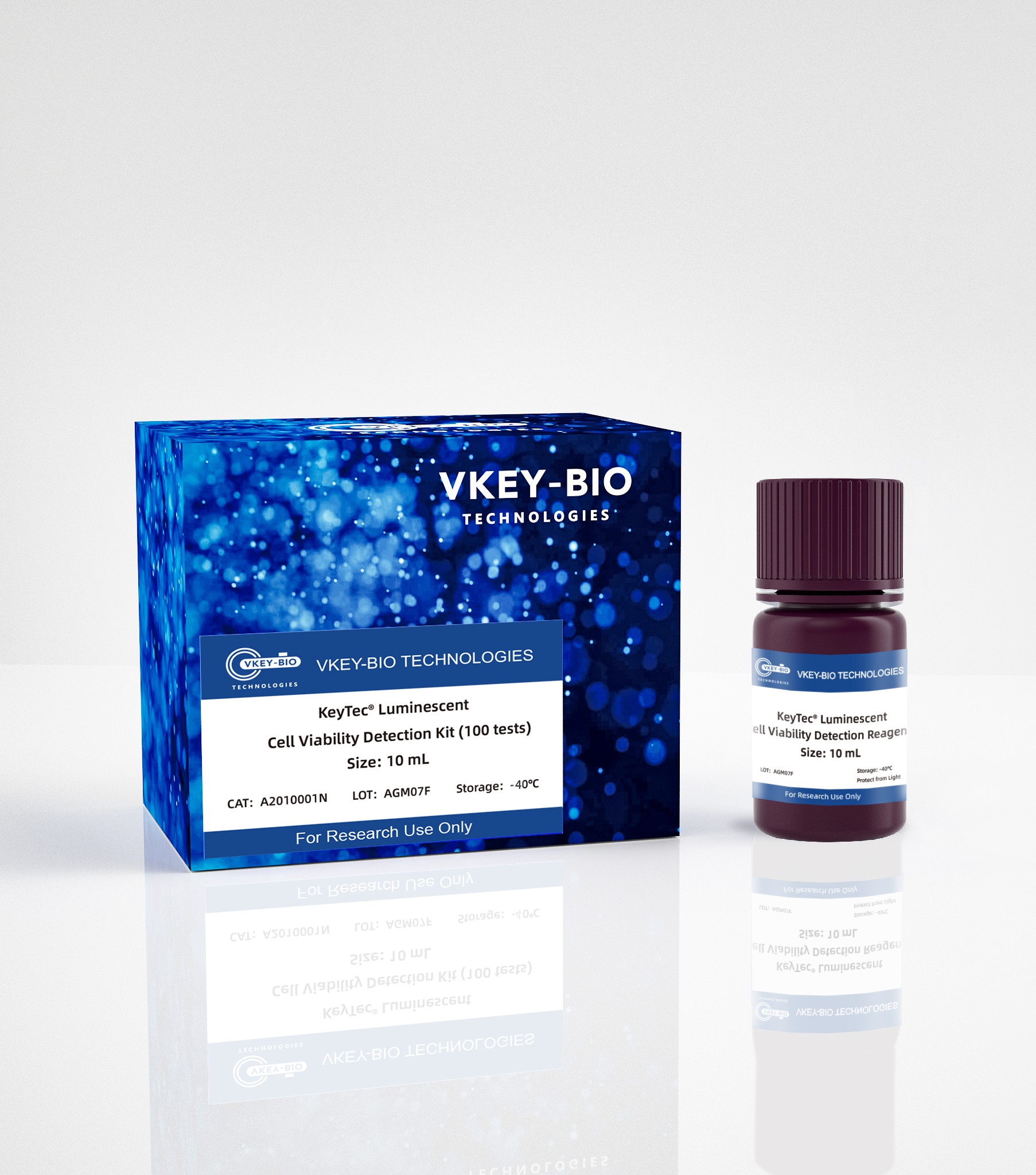
A2010001N_1.1
A2010001N_1.2
A2010001N_1.3
A2010001N_1.1
A2010001N_1.1
A2010001N_1.1
A2010001N_1.2
A2010001N_1.3
A2010001N_1.1
A2010001N_1.1
A2010001N_1.1.jpg
A2010001N_1.2.jpg
A2010001N_1.3.jpg
A2010001N_1.1.jpg
A2010001N_1.1.jpg
A2010001N_1.1.jpg
A2010001N_1.2.jpg
A2010001N_1.3.jpg
A2010001N_1.1.jpg
A2010001N_1.1.jpg
A2010001N_1.1.jpg
A2010001N_1.2.jpg
A2010001N_1.3.jpg
A2010001N_1.1.jpg
A2010001N_1.1.jpg
A2010001N_1.1.jpg
A2010001N_1.2.jpg
A2010001N_1.3.jpg
A2010001N_1.1.jpg
A2010001N_1.1.jpg
Luminescent Assay for Detecting the Number of Viable Cells in Culture

What it is:It is a luciferase-based luminescent assay that quantifies viable cells by directly measuring intracellular ATP levels.

What it’s used for: It is used for cell viability, proliferation, and cytotoxicity readouts in 2D cell culture and high-throughput screening applications.

Why it’s different: Unlike other cell viability kits, it features a fast mix-and-read workflow (total ~12–15 min), glow-type signal stability with a half-life of 3–5 hours, and excellent post-thaw storage stability (30 days at room temperature or 60 days at 2–8°C, with ≥90% activity remaining).

•  Excellent Storage Stability: Thawed reagent can be stored at room temperature (≤ 24.5 ℃) for 30 days or at 2-8 ℃ for 60 days (≥90% activity)
•  High Sensitivity: Wider linear range with low background and high signal
•  The luminescence signal is not only high but also robust, with a half-life of approximately 3-5 h. It is suitable for most assay formats
Luminescent Assay for Detecting the Number of Viable Cells in Culture

•  Excellent Storage Stability: Thawed reagent can be stored at room temperature (≤ 24.5 ℃) for 30 days or at 2-8 ℃ for 60 days (≥90% activity)
•  High Sensitivity: Wider linear range with low background and high signal
•  The luminescence signal is not only high but also robust, with a half-life of approximately 3-5 h. It is suitable for most assay formats

Luminescent Assay for Detecting the Number of Viable Cells in Culture

• Excellent Storage Stability: Thawed reagent can be stored at room temperature (≤ 24.5 ℃) for 30 days or at 2-8 ℃ for 60 days (≥90% activity)
• High Sensitivity: Wider linear range with low background and high signal
• The luminescence signal is not only high but also robust, with a half-life of approximately 3-5 h. It is suitable for most assay formats

Luminescent Assay for Detecting the Number of Viable Cells in Culture

• Excellent Storage Stability: Thawed reagent can be stored at room temperature (≤ 24.5 ℃) for 30 days or at 2-8 ℃ for 60 days (≥90% activity)
• High Sensitivity: Wider linear range with low background and high signal
• The luminescence signal is not only high but also robust, with a half-life of approximately 3-5 h. It is suitable for most assay formats

Luminescent Assay for Detecting the Number of Viable Cells in Culture

• Excellent Storage Stability: Thawed reagent can be stored at room temperature (≤ 24.5 ℃) for 30 days or at 2-8 ℃ for 60 days (≥90% activity)
• High Sensitivity: Wider linear range with low background and high signal
• The luminescence signal is not only high but also robust, with a half-life of approximately 3-5 h. It is suitable for most assay formats

Luminescent Assay for Detecting the Number of Viable Cells in Culture

• Excellent Storage Stability: Thawed reagent can be stored at room temperature (≤ 24.5 ℃) for 30 days or at 2-8 ℃ for 60 days (≥90% activity)
• High Sensitivity: Wider linear range with low background and high signal
• The luminescence signal is not only high but also robust, with a half-life of approximately 3-5 h. It is suitable for most assay formats

Size:
10 mL
2*50 mL
2*250 mL
4*250 mL
10*50 mL
20*50 mL
Price:
$ 85
CAT.:
A2010001N
Delivery:
Available in Stock
Price:
$ 341
CAT.:
A2010002N
Delivery:
Available in Stock
Price:
$ 1221
CAT.:
A2010003N
Delivery:
Available in Stock
Price:
$ 2808
CAT.:
A2010004N
Delivery:
Available in Stock
Price:
$ 1343
CAT.:
A2010005N
Delivery:
Available in Stock
Price:
$ 3089
CAT.:
A2010006N
Delivery:
Available in Stock
Sample Request PDF Download
KeyTec® Luminescent Cell Viability Detection Kit
10 mL
10 mL
2*50 mL
2*250 mL
4*250 mL
10*50 mL
20*50 mL
CAT.: A2010001N
$ 85 $ 341 $ 1221 $ 2808 $ 1343 $ 3089
Overview
Performance
Protocols
Components
Notices
FAQs about KeyTec® Luminescent Cell Viability Detection Kit
Related Products

Overview

KeyTec® Luminescent Cell Viability Detection kit (LCV) is designed for cell viability detection. It quantifies viable cells by measuring the ATP present, a key indicator of metabolically active cells. The homogeneous assay procedure involves adding a single reagent directly to cells cultured in serum-supplemented medium.
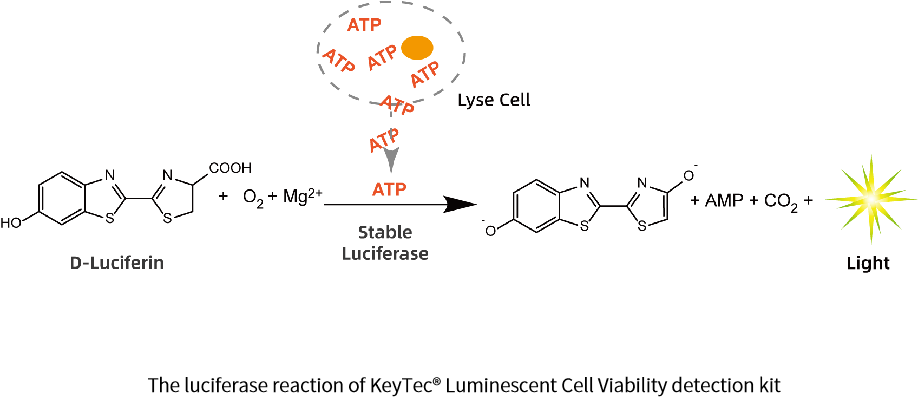
The detection principle is based on Luminescent technology. Within the kit, D-Luciferin and luciferase react with ATP released by cells, generating a sensitive and robust luminescent signal. With a luminescent signal half-life of 3-5 hours, ensuring high sensitivity and robust performance. Additionally, the kit shows excellent storage stability, maintaining above 90% activity after 30 days at room temperature or 60 days at 2-8 °C. Its sensitivity and operational flexibility make it ideal for high-throughput screening (HTS), cell proliferation and cytotoxicity assays

EN_A2010001N_2.1

Performance

performance


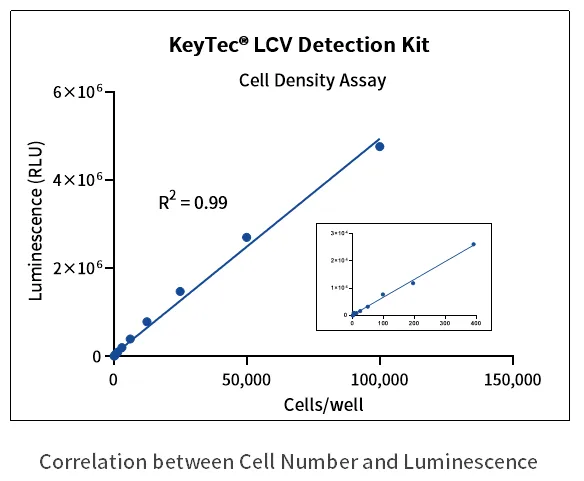
Use KeyTec® Luminescent Cell Viability Detection kit to detect cell viability of HeLa cell line. The results showed a linear relationship between the luminescent signal and the linear range across four orders of magnitude. Hela cells, cultured in DMEM medium with 10% FBS, were serially diluted two-fold, starting from 100,000 cells per well in a 96-well plate. The luminescent signal exhibits a linear relationship (R² = 0.99) with cell number per well.

Protocols

Components

CAT. Description Size
A2010001N KeyTec® Luminescent Cell Viability Detection Kit 10 mL

Each kit contains sufficient reagents to perform 100 tests of 100 μL/well.
The kit contains the following components:
  •  1 × 10 mL KeyTec® Luminescent Cell Viability Detection Reagent      

Notices

Certificate of Analysis Limitations Storage Conditions
LOT. For research use only -20 ℃

-20 ℃

Overview

KeyTec® Luminescent Cell Viability Detection kit (LCV) is a luminescent ATP detection assay kit designed for cell viability detection. It quantifies viable cells by measuring the ATP present, a key indicator of metabolically active cells. The homogeneous assay procedure involves adding a single reagent directly to cells cultured in serum-supplemented medium.


As a luciferase detection kit, its principle is based on luminescent technology. Within the kit, D-Luciferin and luciferase react with ATP released by cells, generating a sensitive and robust luminescent signal. The signal has a half-life of 3–5 hours, ensuring high sensitivity and stable performance. Additionally, the kit shows excellent storage stability, maintaining above 90% activity after 30 days at room temperature or 60 days at 2–8 °C. Its sensitivity and operational flexibility make it ideal for high-throughput screening (HTS), cell proliferation, and cytotoxicity assays.


EN_A2010001N_2.1

Performance

Use KeyTec® Luminescent Cell Viability Detection kit to detect cell viability of HeLa cell line. The results showed a linear relationship between the luminescent signal and the linear range across four orders of magnitude. Hela cells, cultured in DMEM medium with 10% FBS, were serially diluted two-fold, starting from 100,000 cells per well in a 96-well plate. The luminescent signal exhibits a linear relationship (R² = 0.99) with cell number per well.

KeyTec® Luminescent Cell Viability Detection Kit A2010002N

Protocols

Components

CAT. Description Size
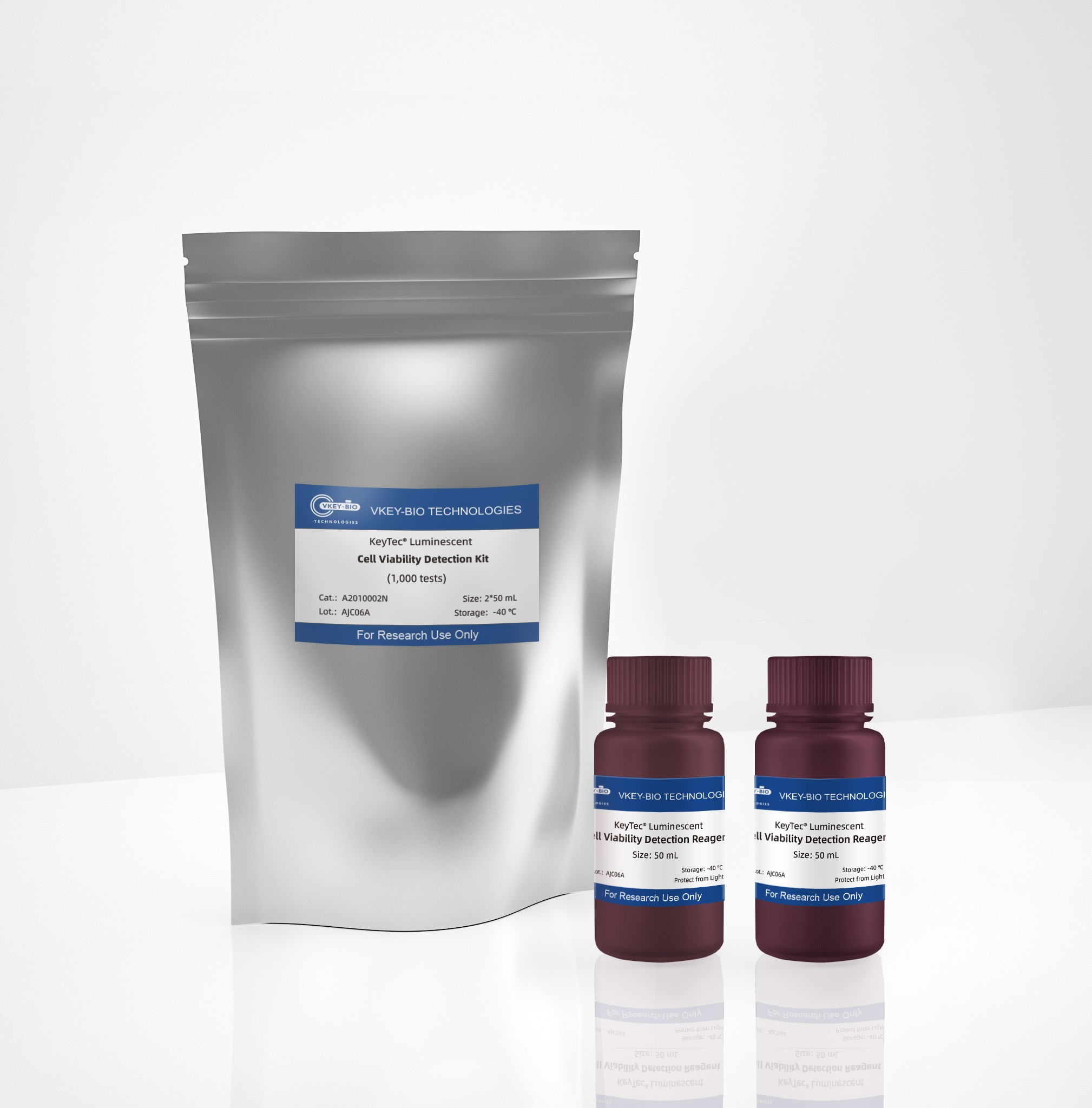
A2010002N KeyTec® Luminescent Cell Viability Detection Kit 2*50 mL

Each kit contains sufficient reagents to perform 1,000 tests of 100 μL/well.
The kit contains the following components:
  •  2 × 50 mL KeyTec® Luminescent Cell Viability Detection Reagent    

Notices

Certificate of Analysis Limitations Storage Conditions
LOT. For research use only -20 ℃

-20 ℃

Overview

KeyTec® Luminescent Cell Viability Detection kit (LCV) is designed for cell viability detection. It quantifies viable cells by measuring the ATP present, a key indicator of metabolically active cells. The homogeneous assay procedure involves adding a single reagent directly to cells cultured in serum-supplemented medium.
The detection principle is based on Luminescent technology. Within the kit, D-Luciferin and luciferase react with ATP released by cells, generating a sensitive and robust luminescent signal. With a luminescent signal half-life of 3-5 hours, ensuring high sensitivity and robust performance. Additionally, the kit shows excellent storage stability, maintaining above 90% activity after 30 days at room temperature or 60 days at 2-8 °C. Its sensitivity and operational flexibility make it ideal for high-throughput screening (HTS), cell proliferation and cytotoxicity assays
EN_A2010001N_2.1.png

Performance

Protocols

Components

CAT. Description Size
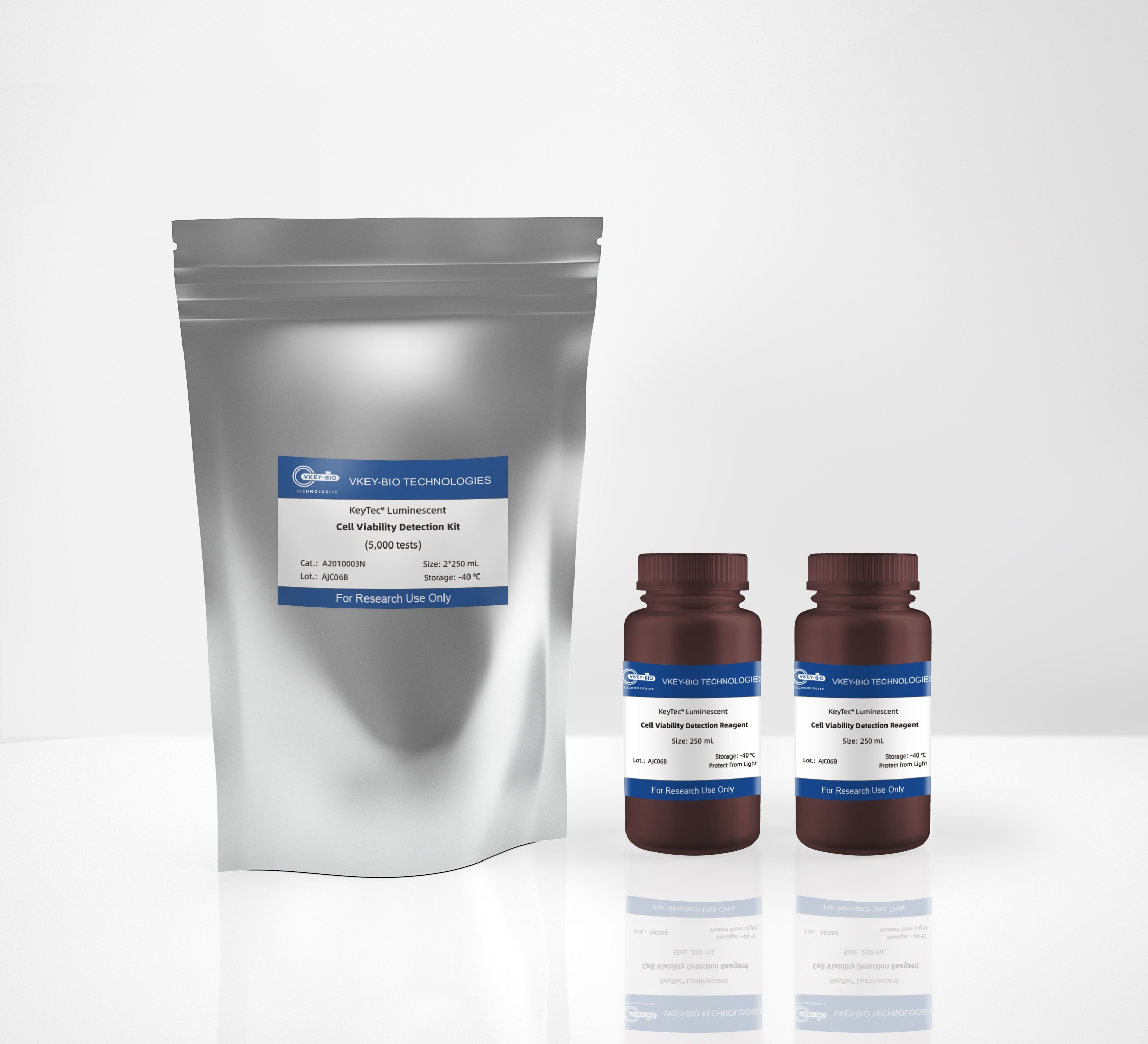
A2010003N KeyTec® Luminescent Cell Viability Detection Kit 2*250 mL
Each kit contains sufficient reagents to perform 5,000 tests of 100 μL/well.
The kit contains the following components:
• 10 × 50 mL KeyTec® Luminescent Cell Viability Detection Reagent

Notices

Certificate of Analysis Limitations Storage Conditions
LOT. For research use only -20 ℃

-20 ℃

Overview

KeyTec® Luminescent Cell Viability Detection kit (LCV) is designed for cell viability detection. It quantifies viable cells by measuring the ATP present, a key indicator of metabolically active cells. The homogeneous assay procedure involves adding a single reagent directly to cells cultured in serum-supplemented medium.
The detection principle is based on Luminescent technology. Within the kit, D-Luciferin and luciferase react with ATP released by cells, generating a sensitive and robust luminescent signal. With a luminescent signal half-life of 3-5 hours, ensuring high sensitivity and robust performance. Additionally, the kit shows excellent storage stability, maintaining above 90% activity after 30 days at room temperature or 60 days at 2-8 °C. Its sensitivity and operational flexibility make it ideal for high-throughput screening (HTS), cell proliferation and cytotoxicity assays
EN_A2001100N_2.1.png

Performance

Protocols

Components

CAT. Description Size
A2010004N KeyTec® Luminescent Cell Viability Detection Kit 4*250 mL
Each kit contains sufficient reagents to perform 10,000 tests of 100 μL/well.
The kit contains the following components:
• 2 × A2010003N KeyTec® Luminescent Cell Viability Detection Reagent

Notices

Certificate of Analysis Limitations Storage Conditions
LOT. For research use only -20 ℃

-20 ℃

Overview

KeyTec® Luminescent Cell Viability Detection kit (LCV) is designed for cell viability detection. It quantifies viable cells by measuring the ATP present, a key indicator of metabolically active cells. The homogeneous assay procedure involves adding a single reagent directly to cells cultured in serum-supplemented medium.
The detection principle is based on Luminescent technology. Within the kit, D-Luciferin and luciferase react with ATP released by cells, generating a sensitive and robust luminescent signal. With a luminescent signal half-life of 3-5 hours, ensuring high sensitivity and robust performance. Additionally, the kit shows excellent storage stability, maintaining above 90% activity after 30 days at room temperature or 60 days at 2-8 °C. Its sensitivity and operational flexibility make it ideal for high-throughput screening (HTS), cell proliferation and cytotoxicity assays
EN_A2010001N_2.1.png

Performance

Protocols

Components

CAT. Description Size
A2010005N KeyTec® Luminescent Cell Viability Detection Kit 10*50 mL
Each kit contains sufficient reagents to perform 5,000 tests of 100 μL/well.
The kit contains the following components:
• 10 × 50 mL KeyTec® Luminescent Cell Viability Detection Reagent

Notices

Certificate of Analysis Limitations Storage Conditions
LOT. For research use only -20 ℃

-20 ℃

Overview

KeyTec® Luminescent Cell Viability Detection kit (LCV) is designed for cell viability detection. It quantifies viable cells by measuring the ATP present, a key indicator of metabolically active cells. The homogeneous assay procedure involves adding a single reagent directly to cells cultured in serum-supplemented medium.
The detection principle is based on Luminescent technology. Within the kit, D-Luciferin and luciferase react with ATP released by cells, generating a sensitive and robust luminescent signal. With a luminescent signal half-life of 3-5 hours, ensuring high sensitivity and robust performance. Additionally, the kit shows excellent storage stability, maintaining above 90% activity after 30 days at room temperature or 60 days at 2-8 °C. Its sensitivity and operational flexibility make it ideal for high-throughput screening (HTS), cell proliferation and cytotoxicity assays
EN_A2001100N_2.1.png

Performance

Protocols

Components

CAT. Description Size
A2010006N KeyTec® Luminescent Cell Viability Detection Kit 20*50 mL
Each kit contains sufficient reagents to perform 10,000 tests of 100 μL/well.
The kit contains the following components:
• 2 × A2010005N KeyTec® Luminescent Cell Viability Detection Reagent(5,000 tests)

Notices

Certificate of Analysis Limitations Storage Conditions
LOT. For research use only -20 ℃

-20 ℃

FAQs about KeyTec® Luminescent Cell Viability Detection Kit

Q
What is the KeyTec® Luminescent Cell Viability Detection Kit used for?
A

The KeyTec® Luminescent Cell Viability Detection Kit is used for quantifying viable cells in culture by measuring ATP content, a key indicator of metabolically active cells. It is commonly applied in cell proliferation and cytotoxicity assays. The kit operates on a luciferase-based chemiluminescence principle, providing a homogeneous “add-mix-read” protocol.

Q
Is the KeyTec® Cell Viability Kit suitable for high-throughput screening (HTS)?
A

Yes, the kit is well-suited for high-throughput screening. It features a “glow-type” luminescence with a half-life of 3–5 hours, excellent storage stability (≥90% activity after 30 days at room temperature or 60 days at 2–8°C), and a simple protocol that requires only adding an equal volume of reagent to the cell culture, shaking for 2–5 minutes, and incubating for 10 minutes before reading. These characteristics make it ideal for HTS applications.

Q
What cell types can be tested with this kit?
A

The kit has been validated with HeLa cells, as shown in the product data. In principle, it can be used for a wide range of adherent or suspension cell types, including primary cells and cell lines, as long as the cells are cultured in standard media (e.g., DMEM with serum). However, the manufacturer notes that different cell types and culture media may affect luminescence intensity and decay rates, so initial optimization for each specific cell type is recommended.

Q
How sensitive is the KeyTec® Luminescent Cell Viability Detection Kit?
A

The kit is highly sensitive. In data shown using HeLa cells, a luminescent signal significantly above background (three times the background of serum-containing medium without cells) was detected from as few as 25 cells per well in a 96-well plate. The linear detection range spans four orders of magnitude, from approximately 5 to 100,000 cells per well, with an R² value of 0.99.

Related Cell Viability Assays

VKEY-BIO Provides High-Quality Life Science Reagents For You!
Cooperative Development
(+86)-021-5835-6939
Phone Number (+86)-021-5835-6939
marketing@vkeybio.com
Email marketing@vkeybio.com
Location
Location Floor 3, Building 2, Lane 898, Halei Road, Pudong New Area, Shanghai, China
Name *
Telephone
Email *
Company
Message *
Sample Request
We look forward to your order and to jointly advancing the development of life science research. Product Name KeyTec Enhanced Luciferase Detection Kit
Reason For Application *
Corporate OR Research Group *
Address *
Name *
Telephone *
Mailbox *
Verification Code *