KeyTec® TR-FRET Phospho-EGFR (Y1068) Kit
Size: Sandwich Model TR-FRET Assay for Detecting of P-EGFR (Y1068) in Cell Lysates
Price: $
CAT.: A1060365D

• Easy to Use: A homogeneous assay - just follow the 'add-incubate-measure' process
• High Specificity: Use specific antibodies for binding P-EGFR (Y1068), ensuring results accuracy
• Wider range for high concentration, making it more suitable for agonist or antagonistic (with agonist pre-treatment)
• Easy to Use: A homogeneous assay - just follow the 'add-incubate-measure' process
• High Specificity: Use specific antibodies for binding P-EGFR (Y1068), ensuring results accuracy
• Wider range for high concentration, making it more suitable for agonist or antagonistic (with agonist pre-treatment)
• Easy to Use: A homogeneous assay - just follow the 'add-incubate-measure' process
• High Specificity: Use specific antibodies for binding P-EGFR (Y1068), ensuring results accuracy
• Wider range for high concentration, making it more suitable for agonist or antagonistic (with agonist pre-treatment)
The KeyTec® TR-FRET EGFR (Y1068) Phospho-Protein Detection Kit can be used to detect the phosphorylation level at site Y1068 of intracellular EGFR protein after cell lysis. This kit is a sandwich immunoassay developed using KeyTec® TR-FRET technology, featuring simplicity, speed, high specificity, high sensitivity, and good reproducibility.
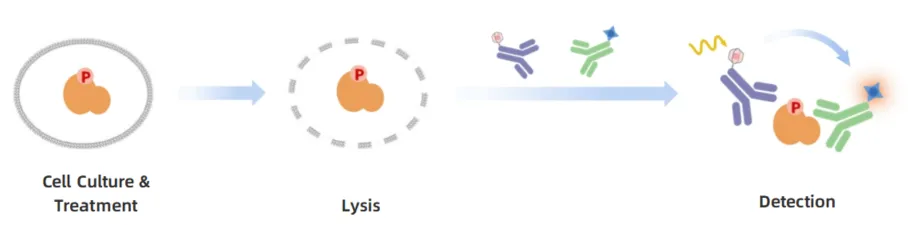
The basic principle of this method is shown in the figure below. A pair of specific antibodies are conjugated to the fluorescent energy donor Solar Eu1 and the fluorescent energy acceptor LA2, respectively. When the EGFR (Y1068) site is phosphorylated, the two antibodies simultaneously bind to different epitopes of the EGFR protein. Upon excitation by an external light source, resonance energy transfer occurs between the donor and acceptor. Measuring the signal intensity at a specific wavelength (665 nm) allows determination of the phosphorylation level at EGFR Y1068.
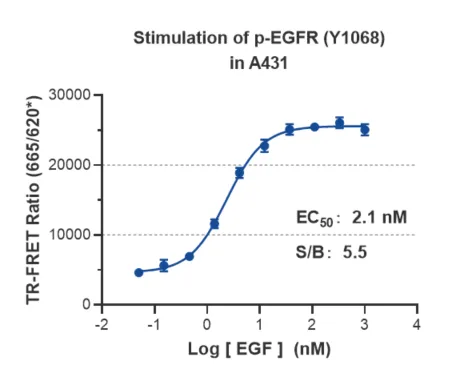
In A431 cells, stimulate phosphorylation of EGFR protein at the Y1068 site
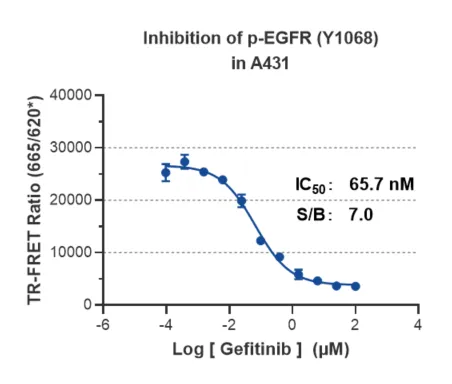
In A431 cells, inhibit phosphorylation of EGFR protein at the Y1068 site
| CAT. | Description | Size |
| A1060365D | KeyTec® TR-FRET Phospho-EGFR (Y1068) Kit | 100 tests |
|
• 1 vial 5 µL/vial Phospho-EGFR (Y1068) Solar Eu & LA Abs mixture • 1 vial 40 µL/vial Positive control lysate • 1 vial 50 µL/vial Phosphatase Inhibitor Cocktail • 1 vial 1 mL/vial KeyTec® TR-FRET Phospho and Total protein Lysis Buffer #6 • 1 vial 500 µL/vial KeyTec® TR-FRET Phospho and Total protein Detection Buffer #6 |
||
| Certificate of Analysis | Limitations | Storage Conditions |
| LOT. | For research use only |

-60℃ or below |
The KeyTec® TR-FRET EGFR (Y1068) Phospho-Protein Detection Kit can be used to detect the phosphorylation level at site Y1068 of intracellular EGFR protein after cell lysis. This kit is a sandwich immunoassay developed using KeyTec® TR-FRET technology, featuring simplicity, speed, high specificity, high sensitivity, and good reproducibility.
The basic principle of this method is shown in the figure below. A pair of specific antibodies are conjugated to the fluorescent energy donor Solar Eu1 and the fluorescent energy acceptor LA2, respectively. When the EGFR (Y1068) site is phosphorylated, the two antibodies simultaneously bind to different epitopes of the EGFR protein. Upon excitation by an external light source, resonance energy transfer occurs between the donor and acceptor. Measuring the signal intensity at a specific wavelength (665 nm) allows determination of the phosphorylation level at EGFR Y1068.
In A431 cells, stimulate phosphorylation of EGFR protein at the Y1068 site
In A431 cells, inhibit phosphorylation of EGFR protein at the Y1068 site
| CAT. | Description | Size |
| A1060365S | KeyTec® TR-FRET Phospho-EGFR (Y1068) Kit | 500 tests |
|
• 1 vial 25 µL/vial Phospho-EGFR (Y1068) Solar Eu & LA Abs mixture • 1 vial 100 µL/vial Positive control lysate • 1 vial 400 µL/vial Phosphatase Inhibitor Cocktail • 1 bottle 8 mL/bottle KeyTec® TR-FRET Phospho and Total protein Lysis Buffer #6 • 1 bottle 2.5 mL/bottle KeyTec® TR-FRET Phospho and Total protein Detection Buffer #6 |
||
| Certificate of Analysis | Limitations | Storage Conditions |
| LOT. | For research use only |
-60℃ or below |
The KeyTec® TR-FRET EGFR (Y1068) Phospho-Protein Detection Kit can be used to detect the phosphorylation level at site Y1068 of intracellular EGFR protein after cell lysis. This kit is a sandwich immunoassay developed using KeyTec® TR-FRET technology, featuring simplicity, speed, high specificity, high sensitivity, and good reproducibility.
The basic principle of this method is shown in the figure below. A pair of specific antibodies are conjugated to the fluorescent energy donor Solar Eu1 and the fluorescent energy acceptor LA2, respectively. When the EGFR (Y1068) site is phosphorylated, the two antibodies simultaneously bind to different epitopes of the EGFR protein. Upon excitation by an external light source, resonance energy transfer occurs between the donor and acceptor. Measuring the signal intensity at a specific wavelength (665 nm) allows determination of the phosphorylation level at EGFR Y1068.
In A431 cells, stimulate phosphorylation of EGFR protein at the Y1068 site
In A431 cells, inhibit phosphorylation of EGFR protein at the Y1068 site
| CAT. | Description | Size |
| A1060365L | KeyTec® TR-FRET Phospho-EGFR (Y1068) Kit | 5,000 tests |
|
• 1 vial 250 µL/vial Phospho-EGFR (Y1068) Solar Eu & LA Abs mixture • 2 vials 100 µL/vial Positive control lysate • 1 bottle 3 mL/bottle Phosphatase Inhibitor Cocktail • 1 bottle 60 mL/bottle KeyTec® TR-FRET Phospho and Total protein Lysis Buffer #6 • 1 bottle 25 mL/bottle KeyTec® TR-FRET Phospho and Total protein Detection Buffer #6 |
||
| Certificate of Analysis | Limitations | Storage Conditions |
| LOT. | For research use only |
-60℃ or below |


 English