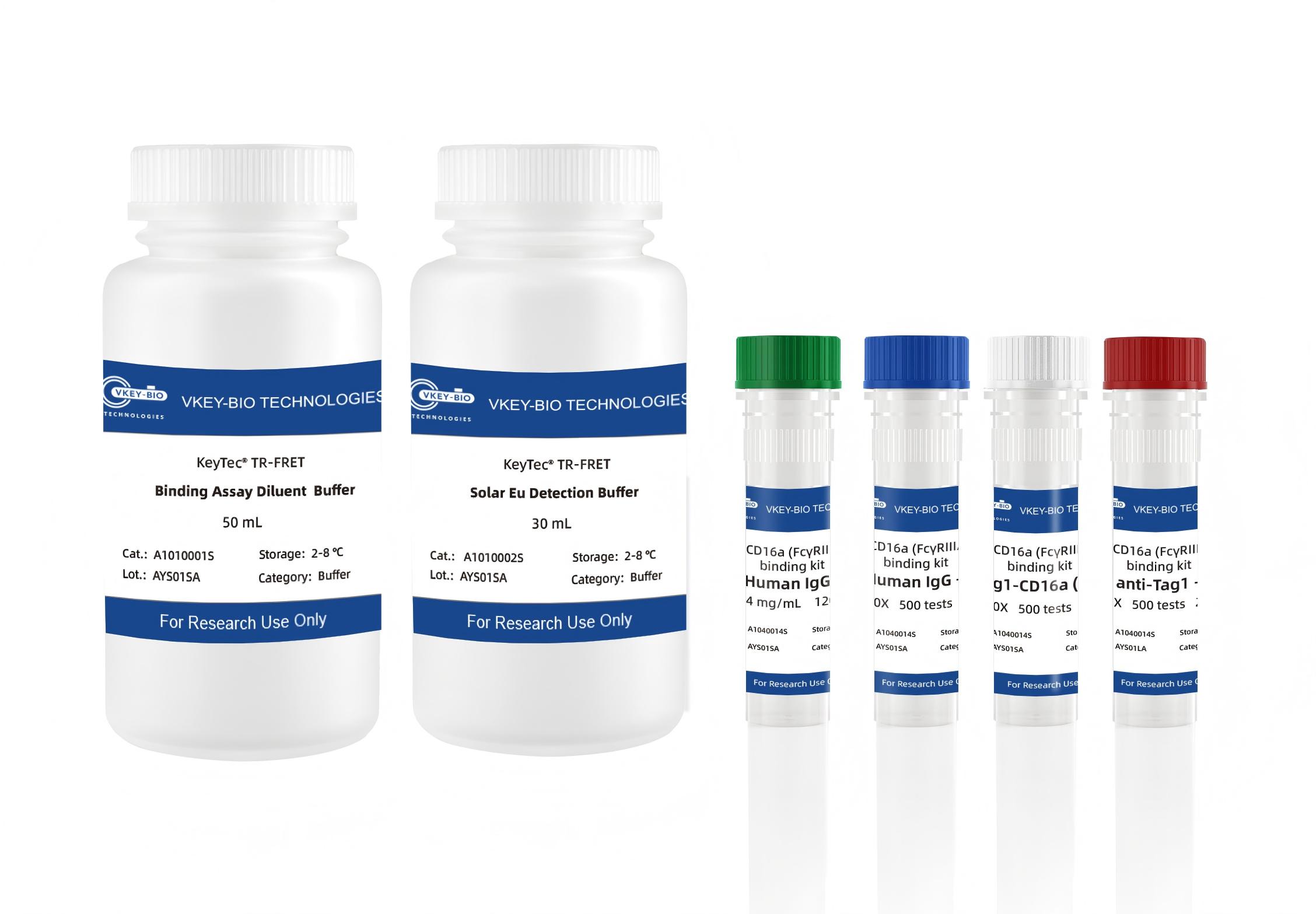
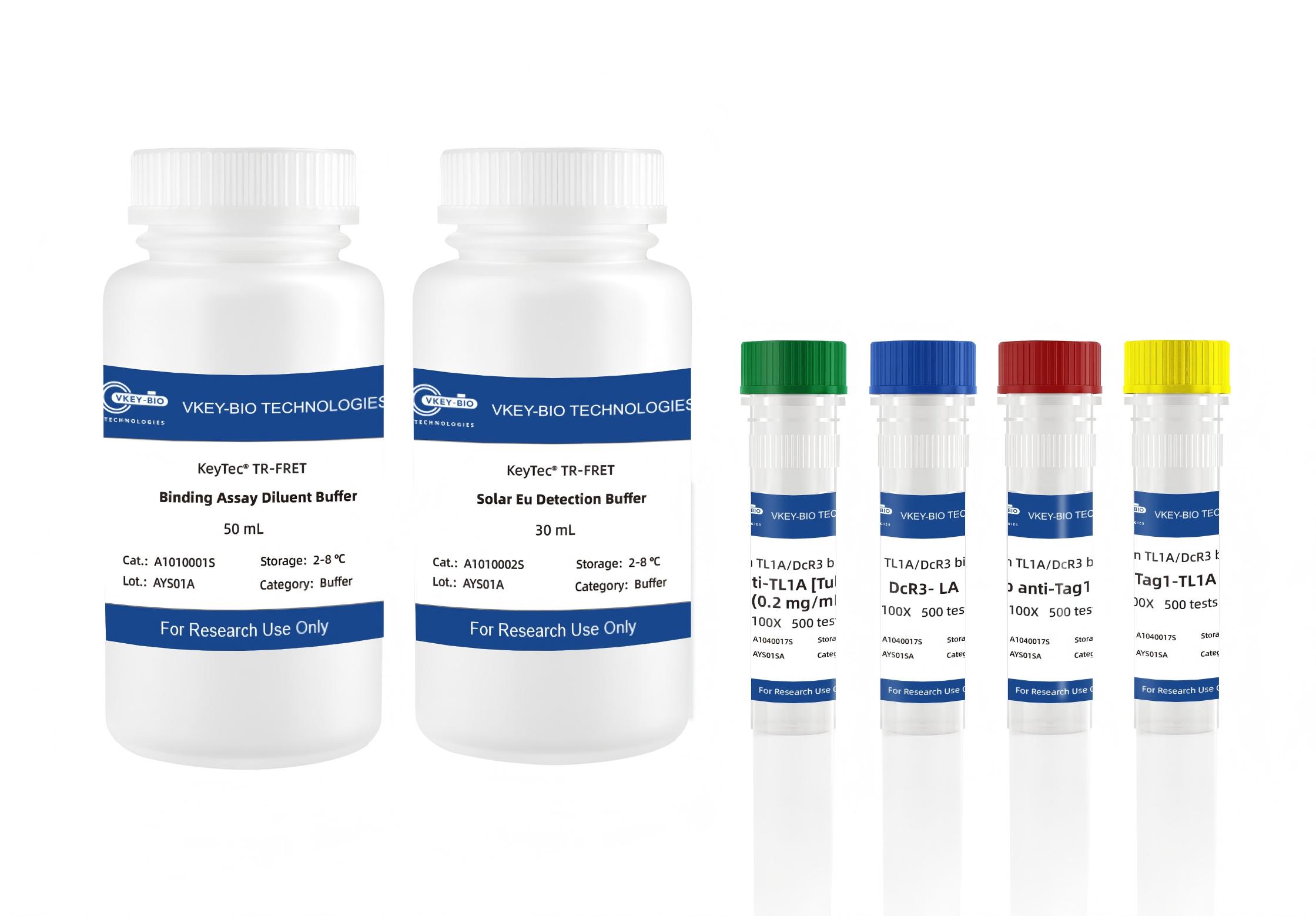
KeyTec® TR-FRET Human TL1A/DcR3 binding kit
Size:
Price: $ Inquire
CAT.: A1040017D

The KeyTec® TR-FRET Human TL1A/DcR3 Binding Assay Kit is designed for screening inhibitors that block the binding between TL1A and DcR3. This kit utilizes KeyTec® TR-FRET technology in a competitive immunoassay format, offering advantages such as simplicity, speed, high accuracy, and excellent reproducibility.
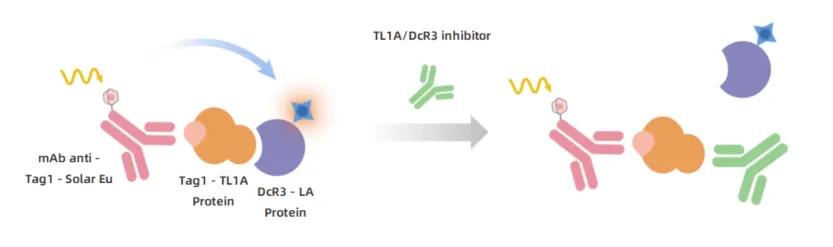
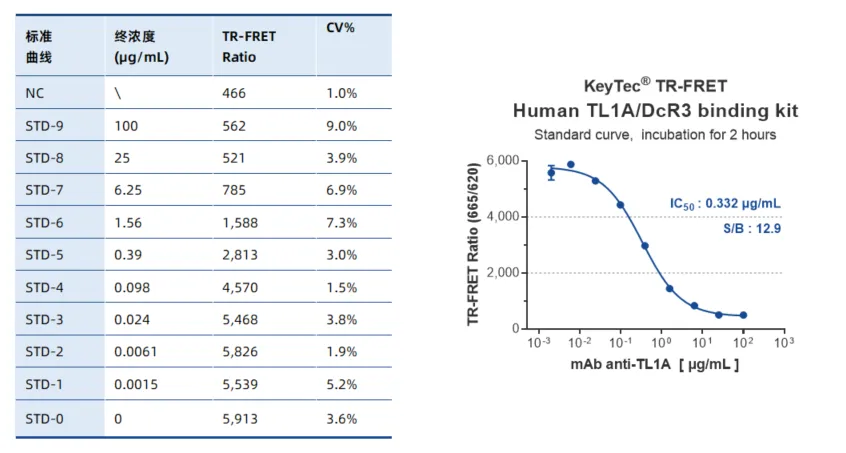
The basic principle of this method is illustrated below: The KeyTec® TR-FRET Solar Eu1-conjugated anti-Tag1 antibody specifically recognizes Tag1-labeled Human TL1A protein. KeyTec® TR-FRET LA2-conjugated Human DcR3 can bind to the TL1A protein, bringing Solar Eu (donor) and LA (acceptor) into close proximity and enabling energy resonance transfer upon external light excitation. By measuring the signal intensity at the specific wavelength (665 nm), the binding level between Human TL1A and Human DcR3 can be determined. When the sample contains inhibitors that disrupt the TL1A/DcR3 interaction, they compete with DcR3-LA for the binding sites on TL1A. As a result, the TR-FRET signal intensity is inversely proportional to the concentration of the inhibitor in the sample.
| CAT. | Description | Size |
| A1040017D | KeyTec® TR-FRET Human TL1A/DcR3 binding kit | 100 tests |
|
• 1 × 1 vial (5 µL/vial) mAb anti-Tag1 - Solar Eu (100X) |
||
| Certificate of Analysis | Limitations | Storage Conditions |
| LOT. | For research use only |

-60℃ or below |
The KeyTec® TR-FRET Human TL1A/DcR3 Binding Assay Kit is designed for screening inhibitors that block the binding between TL1A and DcR3. This kit utilizes KeyTec® TR-FRET technology in a competitive immunoassay format, offering advantages such as simplicity, speed, high accuracy, and excellent reproducibility.
The basic principle of this method is illustrated below: The KeyTec® TR-FRET Solar Eu1-conjugated anti-Tag1 antibody specifically recognizes Tag1-labeled Human TL1A protein. KeyTec® TR-FRET LA2-conjugated Human DcR3 can bind to the TL1A protein, bringing Solar Eu (donor) and LA (acceptor) into close proximity and enabling energy resonance transfer upon external light excitation. By measuring the signal intensity at the specific wavelength (665 nm), the binding level between Human TL1A and Human DcR3 can be determined. When the sample contains inhibitors that disrupt the TL1A/DcR3 interaction, they compete with DcR3-LA for the binding sites on TL1A. As a result, the TR-FRET signal intensity is inversely proportional to the concentration of the inhibitor in the sample.
| CAT. | Description | Size |
| A1040017S | KeyTec® TR-FRET Human TL1A/DcR3 binding kit | 500 tests |
|
• 1 × 1 vial (25 µL/vial) mAb anti-Tag1 - Solar Eu (100X) |
||
| Certificate of Analysis | Limitations | Storage Conditions |
| LOT. | For research use only |
-60℃ or below |
The KeyTec® TR-FRET Human TL1A/DcR3 Binding Assay Kit is designed for screening inhibitors that block the binding between TL1A and DcR3. This kit utilizes KeyTec® TR-FRET technology in a competitive immunoassay format, offering advantages such as simplicity, speed, high accuracy, and excellent reproducibility.
The basic principle of this method is illustrated below: The KeyTec® TR-FRET Solar Eu1-conjugated anti-Tag1 antibody specifically recognizes Tag1-labeled Human TL1A protein. KeyTec® TR-FRET LA2-conjugated Human DcR3 can bind to the TL1A protein, bringing Solar Eu (donor) and LA (acceptor) into close proximity and enabling energy resonance transfer upon external light excitation. By measuring the signal intensity at the specific wavelength (665 nm), the binding level between Human TL1A and Human DcR3 can be determined. When the sample contains inhibitors that disrupt the TL1A/DcR3 interaction, they compete with DcR3-LA for the binding sites on TL1A. As a result, the TR-FRET signal intensity is inversely proportional to the concentration of the inhibitor in the sample.
| CAT. | Description | Size |
| A1040017L | KeyTec® TR-FRET Human TL1A/DcR3 binding kit | 5,000 tests |
|
• 1 × 1 vial (250 µL/vial) mAb anti-Tag1 - Solar Eu (100X) |
||
| Certificate of Analysis | Limitations | Storage Conditions |
| LOT. | For research use only |
-60℃ or below |


 English