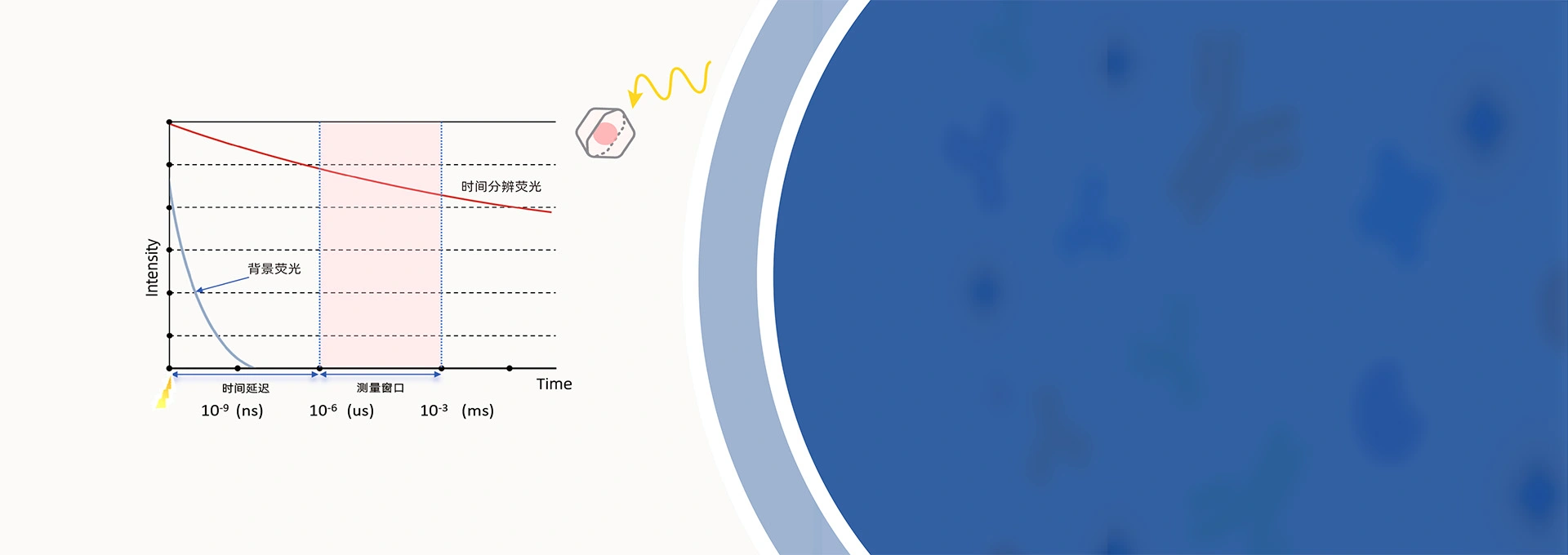
Time-Resolved Fluorescence (TRF) Analysis: This method, often referred to as TRF fluorescence analysis, is based on the long fluorescence effect of lanthanide chelates and involves fluorescence measurements from both time and intensity dimensions. Since its establishment in the 1980s, time resolved fluorescence TRF technology has effectively eliminated the interference of non-specific fluorescence, significantly enhancing analytical sensitivity.

Eu3+/Sm3+ labeling reagents are used to label macromolecules like proteins, peptides, and oligonucleotides, and the resulting markers are suitable for various types of analysis based on solid phase separations. After a series of manipulation steps, the remaining Eu3+/Sm3+-containing marker is immobilized onto a microtiter plate after the unbound portion is washed away. This solution is then added and can dissociate Eu3+/Sm3+ from the immobilized labeled antibody or protein within a few minutes, forming a homogeneous time-resolved fluorescent micellar chelate solution with extremely high brightness. highly sensitive measurements of analytes can be performed.. It is compatible with DELFIA assay.




Immunoassays (TRFIA/DELFIA):
TRF technology is widely used in ultrasensitive immunoassays, such as TR-FLISA and DELFIA, to detect biomarkers, hormones, and infectious agents. By utilizing lanthanide chelates (e.g., Eu³⁺/Sm³⁺), it eliminates short-lived background fluorescence, enabling high signal-to-noise ratios for clinical and research diagnostics.
Drug Discovery & High-Throughput Screening (HTS):
TRF-based assays (e.g., TR-FRET) are critical in HTS for studying protein-protein interactions, enzyme activity, and receptor binding. The long fluorescence lifetime allows gated detection, reducing interference from compound autofluorescence.
Nucleic Acid Detection:
TRF probes quantify DNA/RNA with exceptional sensitivity, applied in PCR, hybridization assays, and SNP genotyping. Lanthanide-labeled oligonucleotides enhance stability and detection limits.
Cell Imaging & Microscopy:
Time-resolved fluorescence imaging visualizes subcellular structures and dynamic processes (e.g., receptor trafficking) by suppressing autofluorescence, ideal for live-cell studies.


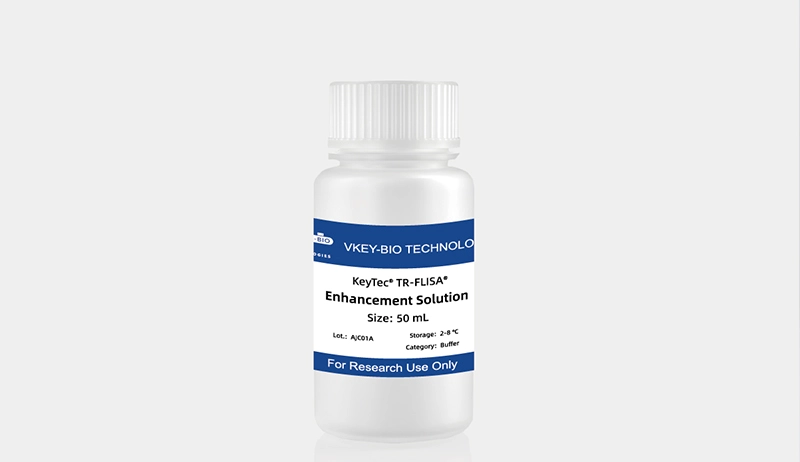
The KeyTec® TR-FLISA® Enhancement Solution is an acidic buffer containing chelators and detergents specifically formulated for time-resolved fluorescence (TRF) applications. It is used to release Eu³⁺/Sm³⁺ ions from labeled antibodies or proteins bound to solid phases (e.g., microplates) after immunoreactions. Upon addition, the solution forms highly fluorescent micellar chelates with the released lanthanides, enabling sensitive detection using a TRF reader. This step is essential in time resolved fluorescence assay workflows, as it significantly reduces background and amplifies signal, embodying the core principle of trf time resolved fluorescence technology.
By efficiently dissociating Eu³⁺/Sm³⁺ from solid-phase bound conjugates and encapsulating them into fluorescent chelates, the KeyTec® TR-FLISA® Enhancement Solution generates intense, long-lived fluorescence. This process minimizes background interference from unbound components and autofluorescence, a common challenge in time resolved fluorescence trf detection. The result is a wide dynamic range and high sensitivity, making it ideal for quantitative analysis in both research and diagnostic time resolved fluorescence assay applications.
The KeyTec® TR-FLISA® Enhancement Solution should be stored at 4 °C for long-term stability. Before use, equilibrate it to room temperature. Always use disposable plastic labware to avoid contamination, as Eu³⁺/Sm³⁺ ions are prone to accumulation and can cause high background. For trf time resolved fluorescence experiments, add 200 μL per well for 96-well plates or 50 μL for 384-well plates. Gently shake for 5 minutes and incubate for 5–30 minutes (optimized based on the chelate type) before measurement. These steps ensure optimal performance in any time resolved fluorescence assay.
Yes, the KeyTec® TR-FLISA® Enhancement Solution is compatible with most microplate readers equipped with a time-resolved fluorescence module. While DELFIA Yellow Plates are recommended for best results, clear standard plates can also be used (note that signal intensities may vary). The solution’s homogeneous format (no-wash steps after addition) simplifies workflow, making it suitable for high-throughput screening and routine time resolved fluorescence trf analysis. Its robust performance supports reliable quantification across various time resolved fluorescence assay formats.

 English