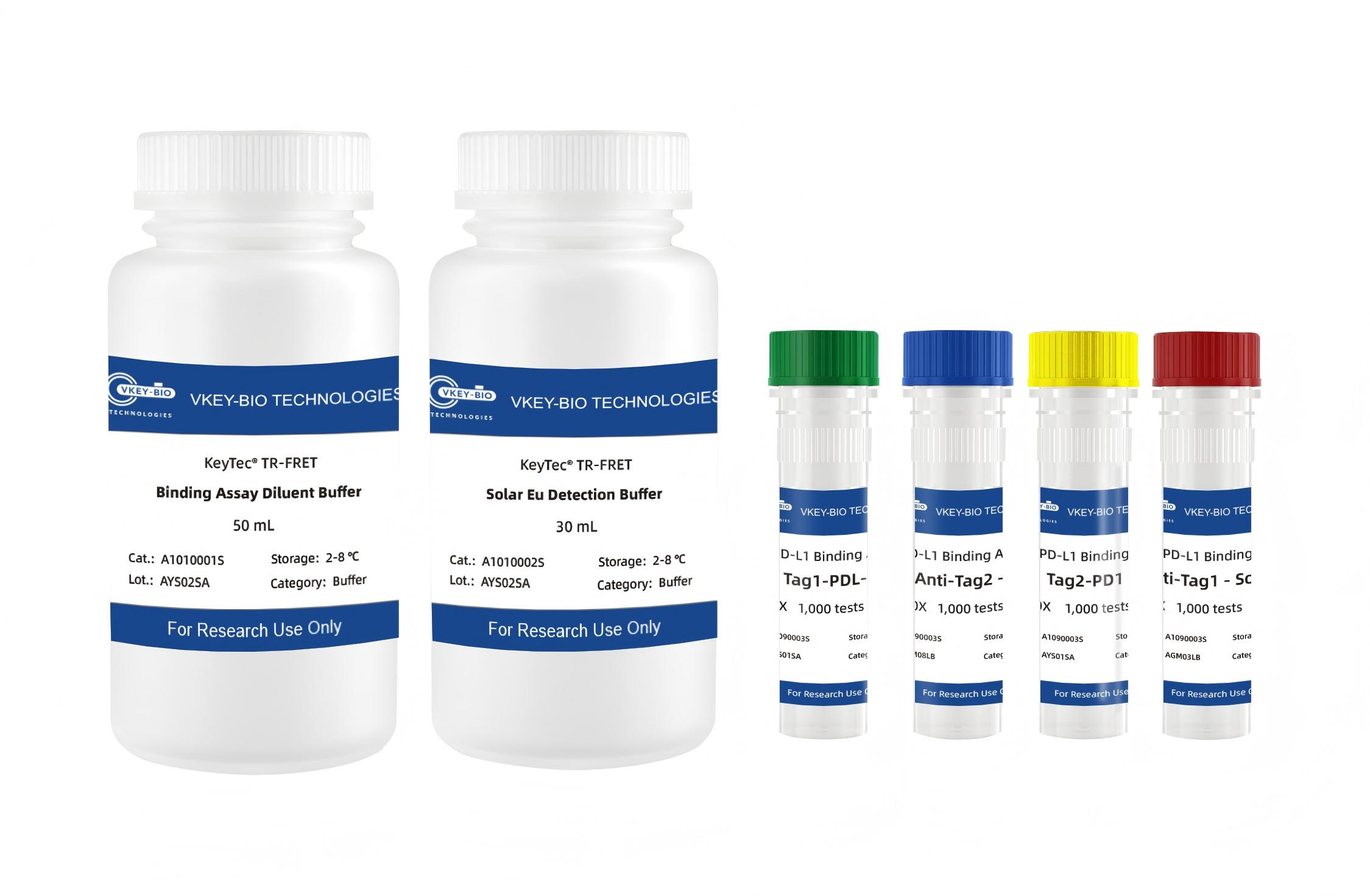
KeyTec® TR-FRET PD1/PD-L1 Binding Assay kit
Size:
Price: $ Inquire
CAT.: A1090003S
• Easy to Use: A homogeneous assay - just follow the 'add-incubate-measure' process
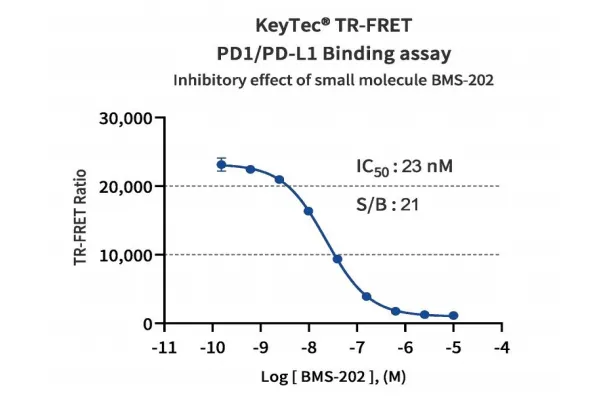
• High S/B: The kit provides a superior window
• Easy to Use: A homogeneous assay - just follow the 'add-incubate-measure' process
• High S/B: The kit provides a superior window
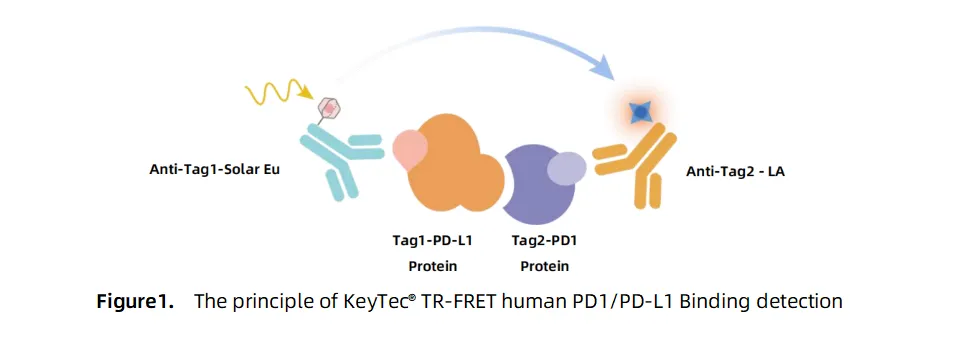
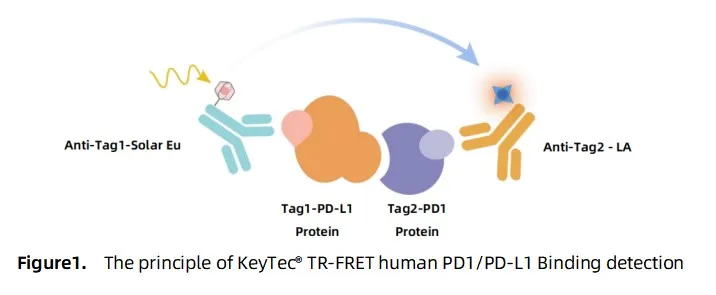
KeyTec® TR-FRET PD1/PD-L1 Binding Assay Kit is designed for the quantitative measurement of the interaction between human PD1 and PD-L1 proteins. This kit provides a Tag1-PD-L1 protein, a Tag2-PD1 protein, an anti-tag1 antibody labeled with KeyTec® TR-FRET Solar Eu* 1 (mAb anti-Tag1 - Solar Eu) ,an anti-tag2 antibody labeled with KeyTec® TR-FRET LA* 2 (mAb anti-Tag2 - LA) and other detection reagents. These components enable the high-throughput screening of small molecule inhibitors, peptides, or antibody blockers. This assay is based on a competitive immunoassay method using KeyTec® TR-FRET technology, offering a simple, rapid, highly specific and sensitive, as well as reproducible detection process. The principle, outlined in Figure 1: The binding of the mAb anti-Tag1 - Solar Eu, the Tag1-PD-L1 protein, the mAb anti-Tag2 - LA and the Tag2-PD1 protein brings the TR-FRET donor and acceptor into close proximity, enabling resonance energy transfer (RET) upon excitation and generating a TR-FRET signal. Compounds, peptides, or antibodies that block the PD1/PD-L1 interaction will cause a decrease in the TR-FRET signal.
* 1 KeyTec® TR-FRET Solar Eu: TR-FRET Donor
* 2 KeyTec® TR-FRET LA: TR-FRET Acceptor
| CAT. | Description | Size |
| A1090003S | KeyTec® TR-FRET PD1/PD-L1 Binding Assay kit | 1,000 tests |
|
The tests are sufficient in a 384-well microplate assay format, with 20 μL per well. |
||
| Certificate of Analysis | Limitations | Storage Conditions |
| LOT. | For research use only |

-60℃ or below |
KeyTec® TR-FRET PD1/PD-L1 Binding Assay Kit is designed for the quantitative measurement of the interaction between human PD1 and PD-L1 proteins. This kit provides a Tag1-PD-L1 protein, a Tag2-PD1 protein, an anti-tag1 antibody labeled with KeyTec® TR-FRET Solar Eu*1 (mAb anti-Tag1 - Solar Eu) ,an anti-tag2 antibody labeled with KeyTec® TR-FRET LA*2 (mAb anti-Tag2 - LA) and other detection reagents. These components enable the high-throughput screening of small molecule inhibitors, peptides, or antibody blockers.
This assay is based on a competitive immunoassay method using KeyTec® TR-FRET technology, offering a simple, rapid, highly specific and sensitive, as well as reproducible detection process. The principle, outlined in Figure 1:
The binding of the mAb anti-Tag1 - Solar Eu, the Tag1-PD-L1 protein, the mAb anti-Tag2 - LA and the Tag2-PD1 protein brings the TR-FRET donor and acceptor into close proximity, enabling resonance energy transfer (RET) upon excitation and generating a TR-FRET signal. Compounds, peptides, or antibodies that block the PD1/PD-L1 interaction will cause a decrease in the TR-FRET signal.
*1 KeyTec® TR-FRET Solar Eu: TR-FRET Donor
*2 KeyTec® TR-FRET HX: TR-FRET Acceptor
| CAT. | Description | Size |
| A1090003L | KeyTec® TR-FRET PD1/PD-L1 Binding Assay kit | 10,000 tests |
|
The tests are sufficient in a 384-well microplate assay format, with 20 μL per well. |
||
| Certificate of Analysis | Limitations | Storage Conditions |
| LOT. | For research use only |
-60℃ or below |


 English


![KeyTec® TR-FRET GDP loaded KRAS[G12D]/RAF1 Binding Assay kit](/uploads/file/product/A1090002S_1.jpg "KeyTec® TR-FRET GDP loaded KRAS[G12D]/RAF1 Binding Assay kit")