The PD-1 signaling pathway is one of the core mechanisms mediating tumor immune evasion. Upon binding to its ligands (PD-L1/PD-L2), PD-1 activates the phosphatases SHP-1/2, truncating T-cell activation signals and inducing T-cell “exhaustion.” To date, 32 PD-1/PD-L1 inhibitors have been approved worldwide, covering 26 cancer types, including non-small cell lung cancer (NSCLC), hepatocellular carcinoma (HCC), melanoma, and others. However, the objective response rate (ORR) of monotherapy varies significantly across cancer types (ranging from 2.3% to 53%), and the majority of patients do not achieve long-term survival benefits due to primary or acquired resistance. This highlights the urgency of exploring resistance mechanisms and developing novel combination strategies.
PD-L2, as another key inhibitory ligand of PD-1, shares structural similarity with PD-L1, but its binding affinity to PD-1 is 2- to 6-fold higher than that of PD-L1. This extremely strong interaction plays a critical role in suppressing cytokine secretion and T-cell proliferation, as well as in reshaping the immunosuppressive microenvironment, and may even explain why some PD-L1-negative patients still respond to immunotherapy.
PD-L2 is not only expressed on tumor cells but is also significantly expressed on immune cells such as T cells, NK cells, and tumor-associated macrophages (TAMs). Its high expression in the tumor microenvironment has been demonstrated to play an important role in tumorigenesis and immune evasion. Clinical data indicate that PD-L2 overexpression is significantly associated with poor prognosis in head and neck squamous cell carcinoma (HNSCC), adenoid cystic carcinoma (ACC), and esophageal cancer. Specifically, in HNSCC patients, elevated PD-L2 expression levels are significantly negatively correlated with worse recurrence-free survival (RFS), progression-free survival (PFS), and overall survival (OS). Additionally, studies in colon cancer have shown that PD-L2 expression is positively correlated with perineural invasion and negatively correlated with the density of CD8⁺ tumor-infiltrating lymphocytes (TILs), indicating a more hostile immune microenvironment.
During tumor metastasis, PD-L2 can activate the epithelial-mesenchymal transition (EMT) process through regulation of the Wnt/β-catenin pathway, thereby promoting tumor invasion. Furthermore, glycosylated PD-L2 can bind to epidermal growth factor receptor (EGFR) on the cell membrane, interfering with the antitumor effects of EGFR inhibitors (such as cetuximab) and thus inducing chemotherapy resistance. These discoveries have opened a new era for deeper understanding of PD-L2 function and provide new insights for enhancing the efficacy of anti-PD-1 therapy.
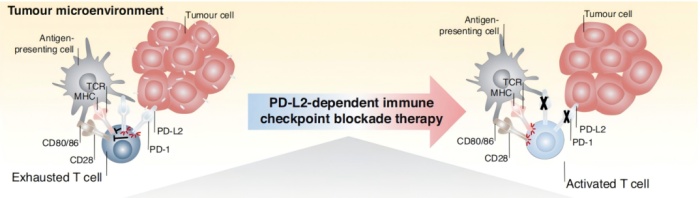
Figure 1. PD-L2-dependent immune checkpoint blockade therapy
Leveraging its proprietary KeyTec® TR-FRET technology, VKEY-BIO has launched the KeyTec® TR-FRET Human PD1/PD-L2 Binding Assay Kit, which can be used for high-throughput screening of small-molecule inhibitors, peptides, or antibody blockers, featuring simplicity, speed, and high accuracy.
Solar Eu-conjugated anti-Tag1 antibody specifically recognizes Tag1-tagged PD-L2 protein, while LA-conjugated anti-Tag2 antibody recognizes Tag2-tagged PD-1 protein. When PD-L2 binds to PD-1, the tag antibodies conjugated with Solar Eu and LA respectively are brought into proximity; upon excitation by an external light source, energy resonance transfer occurs between the donor and acceptor. The extent of the PD-1/PD-L2 protein-protein interaction is determined by measuring the signal intensity at a specific wavelength (665 nm). Consequently, compounds, peptides, or antibodies that block the PD-1/PD-L2 interaction will cause a decrease in the TR-FRET signal.
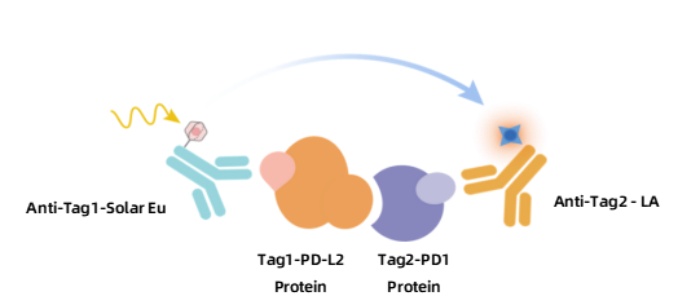
Figure 2. Schematic diagram of the PD-1/PD-L2 binding assay principle
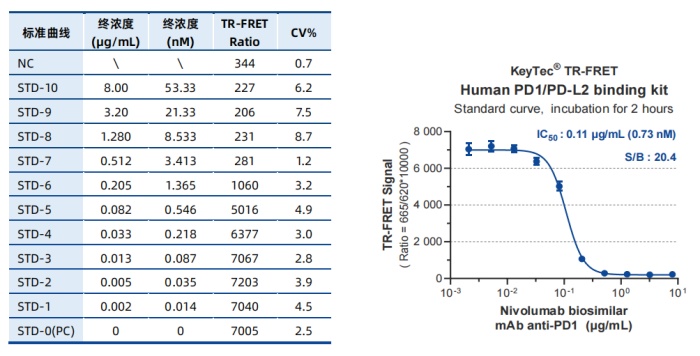
Validation results with standard blocker Anti-PD-1 (Research Grade Nivolumab Biosimilar)
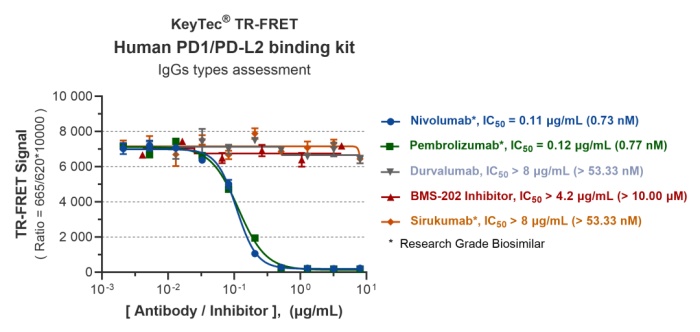
Test results with other blockers
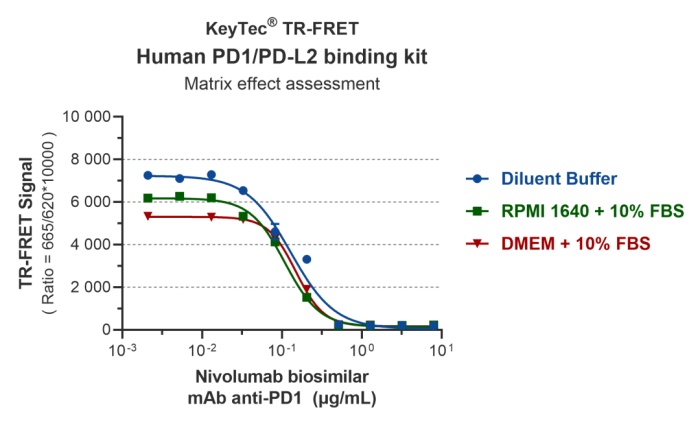
Test results of standard in different matrix solutions (In these tests, 4 μL of Tag1-PD-L2 was pre-incubated with 5 μL of Anti-Tag1–Solar Eu for 15 minutes before sample addition)
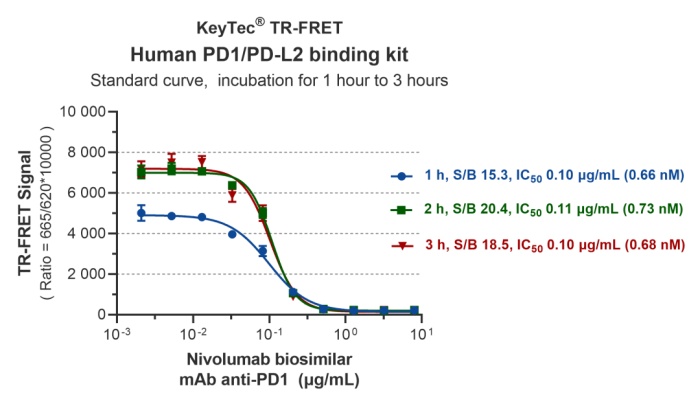
Test results with different incubation times

 English